


Sir Alexander Cunningham: The Rediscoverer of Buddhist India and Father of Indian Archaeology

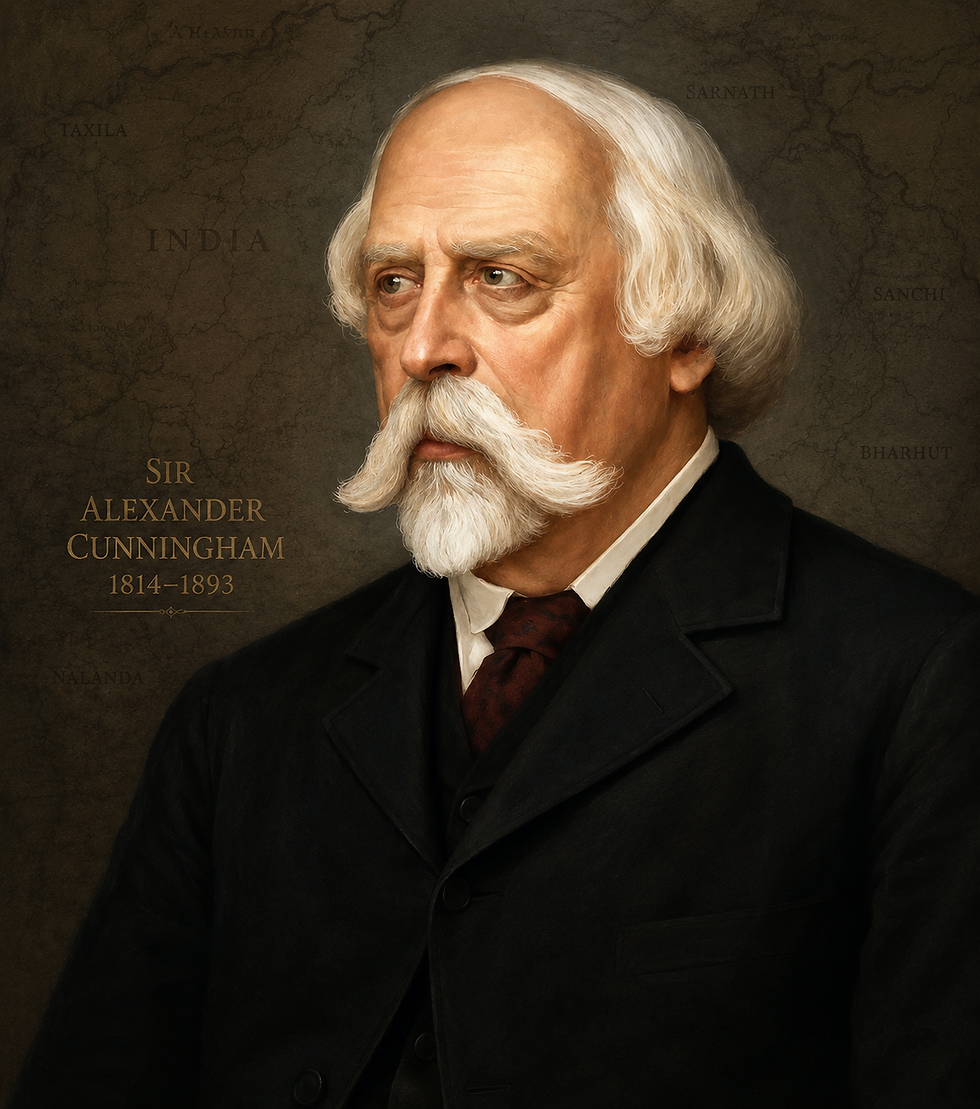
Sir Alexander Cunningham
The nineteenth century witnessed an unprecedented convergence of empire, exploration, and historical inquiry. As European powers extended their political influence across Asia, they also sought to document the history, geography, and cultures of the lands they governed. In British India, this intellectual movement led to the emergence of one remarkable scholar whose work fundamentally transformed the understanding of India's ancient past. Sir Alexander Cunningham (1814–1893), widely regarded as the Father of Indian Archaeology, not only laid the foundations of scientific archaeology in the subcontinent but also played a decisive role in rediscovering the sacred geography of Buddhist India. Through his surveys, excavations, and historical investigations, he brought many of the sites associated with the life of the Buddha and the flourishing of Buddhism back into historical consciousness, thereby reconnecting the modern world with one of India's greatest civilizational legacies [1-3].
Today, Sarnath, Sanchi, Taxila, Nalanda, Bharhut, and numerous other Buddhist sites attract scholars, pilgrims, and tourists from across the globe. Yet, by the beginning of the nineteenth century, many of these monuments had faded into obscurity. Ancient monasteries lay in ruins, stupas remained buried beneath centuries of soil and vegetation, and cities once renowned throughout Asia survived only in scattered literary references. Cunningham's lifelong dedication transformed these forgotten remains into historical evidence, enabling generations of historians, archaeologists, and Buddhists to rediscover India's rich Buddhist heritage [2, 4].
From Military Engineer to Archaeological Pioneer
Alexander Cunningham was born on 23 January 1814 in London into an intellectually distinguished family. His father, Allan Cunningham, was a celebrated Scottish poet and writer whose literary interests undoubtedly influenced his son's curiosity about history and culture. Nevertheless, Cunningham's formal education prepared him for an entirely different profession. He studied at the Addiscombe Military Seminary, the East India Company's training institution for military officers, where he specialised in military engineering. In 1833, at the age of nineteen, he arrived in India as an officer of the Bengal Engineers, expecting a career devoted primarily to engineering and public works [1, 2].
India, however, would alter the course of his life.
The country that Cunningham encountered was unlike anything he had previously known. Across the landscape stood ruined temples, ancient cities, sculptured pillars, monasteries, inscriptions, and mysterious mounds whose historical significance remained largely unexplored. Although India's literary traditions preserved memories of its glorious past, systematic archaeological investigation had scarcely begun. The decline of Buddhism over many centuries further obscured the locations of several important Buddhist centres, leaving them forgotten except in the accounts of ancient pilgrims [2, 5].
A decisive turning point came through Cunningham's association with James Prinsep, one of the nineteenth century's greatest Orientalist scholars. In 1837, Prinsep successfully deciphered the Brahmi script, also referred to as the Dhamma script, enabling scholars for the first time to read the inscriptions of Emperor Ashoka and numerous other ancient rulers. This achievement revolutionised the study of early Indian history by replacing speculation with direct historical evidence. Cunningham was deeply inspired by Prinsep's work and gradually developed an interest that extended far beyond military engineering. He began studying inscriptions, collecting ancient coins, documenting monuments, and exploring historical geography with remarkable enthusiasm [1, 6].
Unlike many of his contemporaries, who viewed India chiefly as a colonial possession, Cunningham increasingly perceived it as a vast historical landscape awaiting rediscovery. He became particularly fascinated by the travel accounts of the Chinese Buddhist pilgrims Faxian (Fa-Hien) and Xuanzang (Hsüan-tsang), whose detailed descriptions of monasteries, stupas, rivers, cities, and pilgrimage routes preserved an invaluable record of Buddhist India. Cunningham realised that these narratives could serve as historical guides for identifying ancient sites whose original names had long disappeared from common usage [2, 7].
What began as intellectual curiosity gradually evolved into a lifelong mission. Cunningham recognised that India's ancient past could be reconstructed only by combining multiple sources of evidence: archaeological remains, inscriptions, coins, architecture, and historical literature. At a time when archaeology had yet to emerge as a formal academic discipline, this interdisciplinary approach was both innovative and remarkably ambitious. Over the following decades, he travelled extensively across northern India, carefully comparing textual descriptions with physical landscapes, measuring monuments, recording inscriptions, and identifying forgotten settlements. His objective was not merely to discover isolated ruins but to reconstruct the historical geography of ancient India itself [1, 2].
A New Vision of India's Buddhist Past
Among the many civilizations that captured Cunningham's attention, Buddhism occupied a central place. The religion had once flourished across the Indian subcontinent, leaving behind an extensive network of monasteries, stupas, educational institutions, and pilgrimage centres. Yet many of these had vanished from public memory. Cunningham understood that archaeology offered a unique opportunity to restore this forgotten heritage through material evidence rather than relying solely on literary tradition.
His work marked a turning point in the study of Buddhist history. For the first time, the sacred landscape described in Buddhist texts and by Chinese pilgrims could be systematically correlated with surviving archaeological remains. This approach not only transformed historical scholarship but also revived international interest in India's Buddhist heritage, laying the foundation for future archaeological exploration and the restoration of many of Buddhism's most sacred sites [2-4].
Rediscovering the Sacred Geography of Buddhism
Cunningham's greatest contribution lay not merely in excavating ancient monuments but in reconstructing the sacred geography of Buddhist India. For centuries, the locations of many sites associated with the Buddha and the early Buddhist Sangha had either been forgotten or remained uncertain. While Buddhist literature and the travel records of the Chinese pilgrims Faxian and Xuanzang preserved valuable descriptions of these places, their precise locations had long been lost. Cunningham resolved to solve this historical puzzle [1, 2].
His approach was remarkably modern. Rather than relying solely on excavation, he combined archaeology, historical geography, epigraphy, numismatics, architecture, and literary evidence. By carefully comparing Xuanzang's itineraries with rivers, hills, distances, and surviving ruins, he succeeded in identifying several ancient Buddhist centres and their modern locations. This interdisciplinary methodology became one of the defining characteristics of Indian archaeology and continues to influence archaeological investigations today [1, 3].
One of Cunningham's earliest and most significant investigations was at Sarnath, near Varanasi, where the Buddha is believed to have delivered his first sermon after attaining Enlightenment. By the nineteenth century, the once-flourishing monastery complex had largely fallen into ruin. Cunningham's systematic surveys confirmed the historical importance of the site, documented its surviving monuments, and provided the first reliable archaeological description of one of Buddhism's holiest pilgrimage centres. His work later facilitated conservation efforts that transformed Sarnath into an internationally recognised centre of Buddhist pilgrimage [3, 4].
His investigations at Sanchi proved equally influential. Although its magnificent stupas had survived the passage of time, their historical significance was not fully understood. Cunningham carefully documented the architecture, inscriptions, sculptural remains, and relic caskets discovered within the stupas. His research demonstrated that Sanchi had served as an important Buddhist monastic centre over several centuries, providing invaluable insight into the evolution of Buddhist art, architecture, and religious patronage [5].
Perhaps his most celebrated achievement was the identification of Taxila, one of the greatest centres of learning in the ancient world. Celebrated in Buddhist literature, Sanskrit traditions, and Greek historical accounts, Taxila had long remained an archaeological mystery. Through painstaking surveys and comparison of literary sources with the physical landscape, Cunningham identified the ancient city and established its historical location. Subsequent excavations confirmed his conclusions, revealing monasteries, stupas, educational institutions, residential quarters, and urban settlements that illustrated Taxila's extraordinary importance as a centre of learning and cultural exchange for nearly a millennium [1, 2].
Cunningham's explorations extended far beyond these celebrated sites. His investigations at Bharhut, Nalanda, Kaushambi, Shravasti, Sankisa, Ahichchhatra, Bodh Gaya, and numerous other locations collectively reconstructed much of the Buddhist landscape of northern India. In many instances, his reports constitute the earliest systematic archaeological records of monuments that have since deteriorated, undergone restoration, or been extensively excavated by later scholars [3, 6].
More importantly, Cunningham fundamentally transformed the study of Buddhism itself. Until the nineteenth century, Buddhism was understood largely through religious literature and travellers' accounts. Cunningham demonstrated that monasteries, stupas, inscriptions, sculptures, relics, and urban remains constituted an equally important historical archive. Archaeology enabled Buddhism to be studied not merely as a philosophical or religious tradition but as a living civilisation whose physical remains revealed patterns of pilgrimage, patronage, education, commerce, and artistic development across the Indian subcontinent [2, 7].
The impact of this rediscovery extended far beyond academic scholarship. By identifying and documenting the sites associated with the Buddha's life and the spread of Buddhism, Cunningham unintentionally contributed to the revival of Buddhist pilgrimage in modern India. Sacred places that had remained neglected for centuries gradually regained their historical and religious significance, attracting pilgrims, scholars, and conservationists from around the world. Although Cunningham himself was neither a Buddhist nor a religious reformer, his archaeological work played a crucial role in reconnecting Buddhism with its Indian homeland [2, 4].
The Archaeological Survey of India: Institutionalising Archaeology
Recognising the need for systematic investigation and preservation of India's antiquities, the Government of India established the Archaeological Survey of India (ASI) in 1861, appointing Cunningham as its first Director General. This marked a turning point in the history of South Asian archaeology. What had previously depended largely on the efforts of individual scholars now became an organised institutional enterprise devoted to documenting, preserving, and interpreting India's archaeological heritage [1, 3].
Under Cunningham's leadership, extensive surveys were undertaken across northern India. Ancient monuments were measured, mapped, photographed, and described with unprecedented precision. Inscriptions were copied and deciphered, coins catalogued, and archaeological reports published regularly, creating an enduring documentary record of India's historical monuments. Many sites that are now protected heritage monuments first entered modern scholarship through Cunningham's meticulous documentation [1, 3].
His scholarship was distinguished by its interdisciplinary character. Rather than relying exclusively on excavation, Cunningham integrated architectural analysis, epigraphy, numismatics, geography, and literary evidence to reconstruct historical narratives. His studies of Indo-Greek, Kushan, Gupta, and regional coinage also made substantial contributions to the chronology of ancient Indian history at a time when reliable historical frameworks were still emerging [1, 8].
Among his most enduring publications are The Ancient Geography of India, The Bhilsa Topes, The Stupa of Bharhut, Mahabodhi, and the multi-volume Archaeological Survey Reports. Although later research has refined some of his conclusions, these works remain indispensable sources for historians and archaeologists, many of whom continue to consult Cunningham's original observations more than a century after they were written [1, 3, 5].
Perhaps Cunningham's greatest institutional legacy was establishing the principle that archaeological heritage should be systematically investigated, scientifically documented, and protected by the state. Today, these principles form the very foundation of archaeological practice in India and continue to guide the Archaeological Survey of India more than 160 years after its establishment.
Legacy, Critique, and Historical Significance
No assessment of Sir Alexander Cunningham can be complete without recognising the colonial context in which he worked. As an officer of the British Empire, his archaeological investigations formed part of a broader imperial enterprise that sought to document the history, geography, and cultures of the territories under colonial administration. Modern scholarship has rightly questioned the relationship between archaeology and colonial power, particularly regarding the ownership of antiquities, the removal of artefacts, and the dominance of European interpretations of India's past. These debates remain important in understanding the evolution of archaeology as a discipline [2, 9].
Yet, the colonial framework should not overshadow Cunningham's extraordinary scholarly achievements. His writings reveal an enduring fascination with India's antiquity and a remarkable commitment to documenting monuments that had been neglected for centuries. Working under difficult conditions and with limited scientific resources, he combined meticulous field observations with literary scholarship, creating a methodological framework that laid the foundations of modern Indian archaeology [1-3].
For Buddhist history, Cunningham's contribution is especially significant. Although the rediscovery of Buddhist India was a collective scholarly endeavour involving pioneers such as James Prinsep, J.D. Beglar, A.C.L. Carlleyle, and later John Marshall, Cunningham was undoubtedly its principal architect. Through decades of exploration, he identified many of the sacred places associated with the Buddha's life, the Mauryan Empire, and the great Buddhist universities and monasteries that had shaped Asian civilisation for centuries. His work transformed scattered ruins into historically authenticated sites, reconnecting literary traditions with physical landscapes [2, 7].
The significance of this achievement extended far beyond archaeology. Cunningham's investigations indirectly contributed to the nineteenth- and twentieth-century Buddhist revival by restoring awareness of India's Buddhist heritage. As archaeological discoveries confirmed the historical authenticity of places mentioned in Buddhist literature, pilgrimage to these sacred sites gradually revived. Centres such as Sarnath, Sanchi, Bodh Gaya, Nalanda, and Taxila once again emerged as places of international religious, historical, and cultural importance [3-6].
Equally important was his institutional legacy. The Archaeological Survey of India, established under his leadership in 1861, became the country's foremost organisation for archaeological research and heritage conservation. More than a century and a half later, the ASI continues to preserve thousands of monuments, many of which first entered modern scholarship through Cunningham's surveys. His annual reports remain indispensable references for historians, archaeologists, and conservationists because they document monuments before later excavations, restoration projects, and natural deterioration altered their original condition [1, 3].
Cunningham was also among the earliest scholars to demonstrate that the history of ancient India could be reconstructed through an interdisciplinary approach integrating archaeology, epigraphy, numismatics, architecture, geography, and textual analysis. This methodology, innovative in the nineteenth century, remains central to archaeological research today. His studies of Ashokan inscriptions, Buddhist monuments, and ancient coinage continue to influence historical scholarship and inspire new generations of researchers [1, 8].
When Sir Alexander Cunningham died in London on 28 November 1893, he left behind a legacy that transcended the boundaries of his own era. More than a century later, historians continue to refine his conclusions, archaeologists continue to build upon his surveys, and pilgrims continue to visit many of the sacred sites that first re-entered historical consciousness through his work [1-3].
Cunningham did not preach the Buddha's Dhamma, compose Buddhist scriptures, or establish a religious movement. His contribution was of a different but equally enduring kind. Through patience, intellectual curiosity, and decades of painstaking exploration, he recovered the material remains of a civilisation that had profoundly shaped Asia's history. In doing so, he ensured that the monasteries, stupas, inscriptions, universities, and sacred landscapes of Buddhist India would no longer remain buried beneath the dust of time.
For this reason, Sir Alexander Cunningham deserves to be remembered not only as the Father of Indian Archaeology, but also as one of the greatest rediscoverers of Buddhist India, whose work restored an invaluable chapter of India's civilisational heritage to the world.
References
Cunningham A. The Ancient Geography of India. London: Trübner & Co.; 1871.
Singh U. The Discovery of Ancient India: Early Archaeologists and the Beginnings of Archaeology. New Delhi: Permanent Black; 2004.
Cunningham A. Archaeological Survey of India Reports. Vols. I–XXV. Government of India; 1871–1887.
Cunningham A. The Bhilsa Topes: Buddhist Monuments of Central India. London: Smith, Elder & Co.; 1854.
Cunningham A. The Stupa of Bharhut. London: W.H. Allen & Co.; 1879.
Cunningham A. Mahabodhi or the Great Buddhist Temple under the Bodhi Tree at Buddha-Gaya. London; 1892.
Singh U. The World of India's First Archaeologist: Letters from Alexander Cunningham to J.D. Beglar. Oxford University Press; 2020.
Cunningham A. Coins of Ancient India. London; 1891.
Chakrabarti DK. A History of Indian Archaeology: From the Beginning to 1947. New Delhi: Munshiram Manoharlal; 1988.
Roy S. The Story of Indian Archaeology, 1784–1947. Archaeological Survey of India; 1961.
Imam A. Sir Alexander Cunningham and the Beginnings of Indian Archaeology. Karachi: Asiatic Society of Pakistan; 1966.


Comments